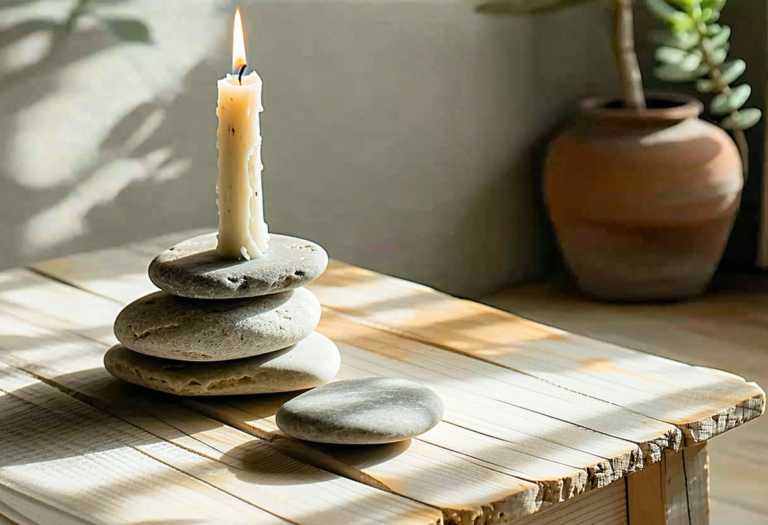
Simple habits that make guests feel welcome while keeping you genuinely present.
A reflection from Contempli — a quiet space for self-discovery and contemplation.
The Quiet Anxiety Behind “Come Over Anytime”
Somewhere between your twenties and now, having friends over shifted from effortless to oddly loaded. You might notice it as a tightening in your chest when someone says, “I’d love to see your place.” Suddenly you’re scanning your apartment through their imagined eyes — the scuffed baseboards, the mismatched mugs, the couch cushion that sags on one side.
Hosting friends as an adult can feel like an unspoken test. Not of your cooking or your décor, but of the life you’ve built. And when it feels like a test, it stops being connection and starts being performance.
This piece is an invitation to examine that shift — and to reclaim something simpler. Not hosting advice dressed up as a lifestyle spread, but a reflection on what it actually means to welcome someone into your space, your real space, and why that vulnerability is worth protecting.
Why Hosting Feels Heavier Than It Used To
When you were younger, hospitality required almost nothing. A floor to sit on, something to drink, maybe music from a laptop speaker. The gathering was the point. No one evaluated the atmosphere because the atmosphere was just… being together.
As adults, we accumulate expectations — some from culture, some from social media, some from our own quiet perfectionism. We absorb images of effortless dinner parties with linen napkins and wildflowers in ceramic vases, and we mistake aesthetics for warmth.
But warmth doesn’t come from presentation. It comes from presence. It comes from the feeling your guest picks up — often unconsciously — that you are relaxed enough to actually be with them rather than managing an experience around them.
When was the last time you felt truly at ease in someone else’s home? What made it feel that way?
Chances are, it wasn’t the food or the furniture. It was the host’s energy — unhurried, unbothered, genuinely glad you were there.
Simple Habits That Create Welcome Without Exhausting You
The goal isn’t to lower your standards. It’s to redirect your energy from impression to connection. Here are a few grounded habits that help:
Make one thing feel intentional
You don’t need everything to be curated. But one small gesture signals care without requiring a production:
- A candle lit before they arrive
- Their favorite drink already cold in the fridge
- A blanket draped on the couch in case the evening gets long
One intentional detail says I thought about you coming here. That’s enough.
Lower the entry barrier for yourself
If hosting feels like a massive undertaking, you’ll avoid it — and then feel isolated, which makes hosting feel even more foreign next time. Break the cycle by making your default invitation smaller:
- “Come over for coffee and nothing else”
- “I’m ordering food — want to eat together at mine?”
- “I have nowhere to be Saturday morning. Come sit with me.”
The less you promise, the less pressure you carry, and paradoxically, the more spacious the time together becomes.
Clean for comfort, not for judgment
There’s a difference between tidying so your friend has a clear place to sit and scrubbing your grout at midnight because you’re afraid of being seen as someone who doesn’t have it together.
A helpful question: Am I cleaning so they’ll be comfortable, or so they won’t think less of me?
The first is hospitality. The second is armor. You deserve to notice the difference.
Let them see the life in your home
The stack of books on your nightstand. The half-finished puzzle on the table. The herbs on the windowsill that are, honestly, struggling. These aren’t messes — they’re evidence that someone lives here, fully and imperfectly. That evidence is what makes a space feel like a home rather than a showroom.
Your friends didn’t come to visit a model apartment. They came to visit you.
The Deeper Layer: What Hosting Reveals About Self-Worth
If you dig beneath the surface of hosting anxiety, you often find a belief that runs deeper than décor preferences. Something like: If they see how I really live, they’ll see who I really am — and that might not be enough.
This is worth sitting with. Not to fix immediately, but to acknowledge.
Opening your door to someone is a small act of vulnerability. You’re saying, in effect, Here is my life. Here is the container I’ve built for my days. When you trust that your home — and by extension, your life — doesn’t need to perform to be worthy of witness, something softens.
Hosting becomes less about proving and more about sharing.
A reflection prompt: Think of a friend whose home you love being in. Now ask yourself — is their home objectively impressive, or does it simply feel like them? That alignment between person and space is what you’re actually drawn to. And your guests feel the same way about yours.
Presence Over Perfection: What Your Guests Actually Remember
Research on memory and social connection consistently shows that people remember how they felt during an experience far more than its details. Your guests will not recall whether you served store-bought or homemade bread. They will recall:
- Whether you seemed happy to see them
- Whether they felt they could relax
- Whether the conversation had room to breathe
- Whether they left feeling closer to you than when they arrived
These things don’t require a perfect home. They require a present host.
Some practical ways to stay present rather than performing:
- Prep what you can before they arrive so you’re not disappearing into the kitchen
- Ask for help — “Can you open that wine?” invites participation, not judgment
- Sit down — physically joining your guests signals that the doing is done and the being has begun
- Let silences exist — not every moment needs to be filled or facilitated
Redefining What “Good Host” Means to You
It might help to consciously rewrite your internal definition. Instead of a good host anticipates every need and makes everything seamless, consider:
A good host makes their guest feel welcome enough to be themselves.
That’s it. That’s the whole job.
And here’s the beautiful paradox: the more permission you give yourself to be imperfect in your own home, the more permission your guest feels to be imperfect too. The performance drops on both sides. What remains is just two people, in a room, being honest about their lives.
That’s not a dinner party. That’s intimacy. And it’s rarer and more nourishing than any perfectly hosted evening.
A Gentle Closing Thought
Your home doesn’t need to earn the right to be shared. It already holds something valuable — the texture of your daily life, the quiet evidence of who you are when no one is watching.
The next time you consider inviting someone over and feel that familiar hesitation — it’s not clean enough, I don’t have anything to offer, it’s not impressive — try pausing. Ask yourself: What if my presence is the offering? What if being welcomed into someone’s real life is the most generous invitation there is?
You might find that the answer has been simple all along. Open the door. Put the kettle on. Let them in.
Want to understand yourself a little better?
Contempli offers gentle, research-informed mini-tests and a quiet space to reflect — no scoreboards, no pressure.